.jpg)
.jpg?1520282740)
Object Record
Images
Metadata
Item ID# |
2014.028.009 a-f |
Object Name |
Horn, French |
Description |
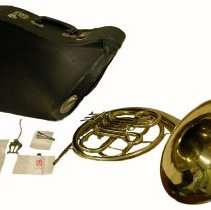
A gold brass French Horn. The horn has only two componets, a mouthpiece (a) that is attached to the main horn shape (b). The horn is stored in a black case (f). The horn's main shape is called the tuning slide. It has a circular shape which holds the three valves that make different tones. The middle valve has "84" stamped underneath. The end of the horn has a large bell which is where the sound comes from. There is a detailed image of a French Horn with parts and locations in image management. The front of the horn near the bell area has an engraved diamond shape design and banner that reads "Waterloo - Student Model". The mouthpiece has "Conn 2" stamped under the rim. Inside the case there are accessories that go with the horn. There is a silver metal clamp stand (c), a piece of sheet music (d) and a tube of valve grease (e). The case is black and has a similar shape to the horn. It has a circular shaped main section and the end of the case is shaped like a bell. The case has 3 metal clasps at the top with a plastic handle. The inside of the case is red velvet and has a black strap to hold the horn in place while transporting. |
Provenance |
This item was used and belonged to the Chesley Citizen's Band which went defunct approximately 20 years ago (circa 1994-1999). The item was stored in the Chesley arena. There is a copy of the history of the Chesley Citizen's Band in the accession file. Musical Inspiration in World War One: The 160th Bruce Battalion Band When, in 1887, Chesley was forced to endure yet another hired band "murdering music within the boundaries of the corporation" the Chesley Band was formed. Attracting talented musicians with promises of employment at the Krug factory, the band became the main source of entertainment in the town. News of their talent spread, and in June 1910 they were selected as the 32nd Battalion Band. In the First World War, the Chesley Band's military service continued. Although the Canadian Department of Militia and Defence did not fund regimental bands, many civilian bands - including Chesley's - enlisted. Volunteering to the 160th Bruce Battalion in 1916 under their bandmaster, George Wright, the band was the central attraction on county recruitment tours. Newspapers, including the Canadian Echo, heralded their arrival with headlines proclaiming, "The 160th Regimental Band Coming here" (Februart 16, 1916). By May, citizens had great hopes for their performance overseas: "Music has a wonderful charm and inspiring effect(...) and the Bruce Band may yet cheer our boys in the field of battle" (May 3, 1916). The Bruce Battalion would be "the best equipped...morally...that ever crossed the sea" (March 8, 1916). On October 18, 1916 the battalion departed for England with the band under the baton of Sgt. William Jack - Wright had been discharged by the Medical Board shortly before their departure. Once in England, they were stationed at the Bramshott Camp in Hampshire, and later in Surrey at Witley Camp. Here, they were once again the main entertainment, playing concerts and dances, in addition to regular drills. As one poet summerized in "Bruce in Khaki" (Nov.16, 1917): "When nearing the end of a long day's toil And the packs weigh near a ton, Watch the steps quicken up and lengthen At the first tap of the drum." As the community had hoped during recruitment, the band kept morale high, using music's uplifting powers to inspire the troops. The band remained in England until February 1918 when the battalion was split between various regiments and sent to France. During this time, the band played "Auld Lang Syne" as the soldiers boarded trains, and provided entertainment at the officers' farewell dinner. As was recorded in the 160th Canadian Infantry Battalion War Diaries "the band [was] a credit to the battalion." By the end of February, the band, too, was divided and sent overseas. After the war, the Chesley Band was revived and continued their legacy until 1999. Their music, which once called soldiers to war and gave hope to the community, is now only an echo. Sources: Canadian Echo newspaper; From Days of Yore: A Pictorial History of Chesley (A995.070.001); Chesley Tweedsmuir History Vol. 3; War Diaries - 160th Canadian Infantry Battalion (from Library and Archives Canada); Historical Notes (A2006.044.001) |
Dimensions |
W-30 L-48 Dia-32 cm |
Search Terms & Subjects |
Marching Bands Music |
Places |
Chesley |
Businesses, Organizations, Ships, Sites |
Chesley Band |