.jpg)
.jpg?1520282740)
Object Record
Images
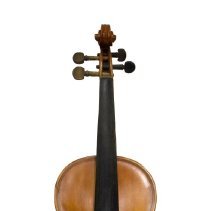
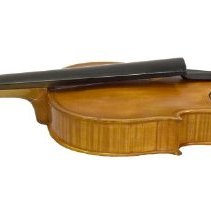
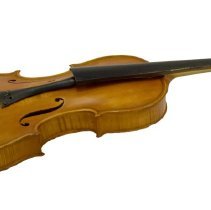
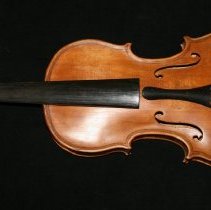
Metadata
Item ID# |
2010.045.001 a-n |
Object Name |
Violin |
Object Name 2 |
Violin, Full-Size |
Year Range from |
1850 |
Year Range to |
1860 |
Description |
[a] Violin: body made of light wood (possibly maple for back, sides, neck, and scroll with spruce for front). Finish on it is of a darker/rosier hue than maple alone. Can see the true colour of the wood on the underside of the neck where handling the violin has worn away the finish (the neck was often not varnished, sometimes polished or lightly sealed to allow for fast position changes). Body has an f-hole on either side facing inward. Around the outside of the violin is a double black-lined border (purfling). There is no chin rest. Fingerboard is black (likely ebony) but faded and joins to a scroll that is the same colour as the body (likely also made of maple). The strings, pegs, bridge, and tailpiece have been removed and comprise the rest of the parts of this donation (except the bridge, which is missing or was never included.) [b] Tailpiece: made of wood, likely ebony (same as fingerboard). Shaped like an elongated triangle but stretching outward at the end rather than coming to a point. Tailgut (two white strings, possibly made of animal intestine) comes out of the smaller end and form loops that would attach to the end button. Raised bridge at the wide end with vertical lines connecting to four round holes for attaching the strings to the fine tuners. [c] Tuning Peg: made of a light wood. Tapered spoke with a circular piece at one end for ease of turning. Circular piece has a concave surface on either side. Spoke has four holes for attaching the string alternating high and low and evenly spaced around its circumference. [d] Tuning Peg: made of a light wood. Tapered spoke with a circular piece at one end for ease of turning. Circular piece has a concave surface on either side. Slightly larger than the first peg. Spoke has four holes for attaching the string alternating high and low and evenly spaced around its circumference. [e] Tuning Peg: made of a darker wood and tapered spoke is much shorter than the first two pegs. The top of this peg resembles a "mushroom" shape, a circle drooping at both sides. The round portion on this peg is convex. The spoke has two holes for attaching the string. [f] Tuning Peg: made of wood, finished in an almost black shade. Tapered spoke is long and not as worn as the others. Two holes in the spoke for strings. Circular piece at top for turning is concave. [g] String: wire string with blue string wrapped around the ends and yellow material (possibly catgut) curving out each end (likely a twisted gut string wound with silver wire, used in 19th century for D and G strings). [h] String: catgut string, yellow (used in 19th century for E and A strings) [i] String: short piece of wire string with blue string wrapped around one end, appears to have been broken in half (entirely steel strings were used starting in the 20th century, widely used following WWI, for the E string). [j] Bow: Long wooden bow, slender, and slightly curved. Finished, wood appears to have a red/black striped pattern, worn to black in the middle. At the tip of the bow is a metal piece and the ends of the bow hairs are still visible. The end that the player holds has a wooden "frog" (anvil shaped piece) with a decorative paua shell "eye" (rectangle insert in the end). The hairs are visible coming from this end as well. The end of the bow is finished with a metal ring around a cylindrical wooden piece (screw for tightening hairs of the bow). [k] Bow: red wooden bow. Bow is long and slender with less curve to it than the other and is not worn (reduction in curve indicates a later style of bow). Uniform red finish with black, textured leather (?) bow pad around stick in front of frog. Hairs are still visible at either end. Frog has rectangle shaped mother of pearl eye on the end. [l] Box of Rosin: purple cardboard box with yellow trim containing rosin for the hair of the bow (increases friction so as to enhance sound production). [m]: Box of Rosin Lid: purple cardboard box lid, rectangular, to fit over top of the box of rosin. [n] Violin Case: wooden case, shaped like long, rounded triangle. Possibly made of maple but finished in same rosy finish as violin. Metal handle on one side. To one side of handle is a metal hook which clasps around metal knob on lid to secure shut. On proper left of handle on the lid is another metal knob but the hook has fallen off. Interior is a purple material which has quite deteriorated, it has faded to white in some parts and a large tear reveals that it is padded with a wiry material. On the inside of the lid is a loop to secure the bows. |
Provenance |
This violin was brought to Canada from Scotland by Thomas Mills. Mills settled in Gresham, part of Bruce Township, in 1854 and operated a blacksmith shop, Post Office and farm. The violin travelled down four generations, reaching Mills' great-grandson. Along the way, the violin was dismantled and partially restored by Thomas' grandson Richard Hugh Mills. |
Dimensions |
H-8 W-21.5 L-61.5 cm |
Lexicon category |
6: T&E For Communication |
Search Terms & Subjects |
Blacksmiths Music |
Places |
Bruce Township Gresham |
Related items within BCM&CC Collection |
Show Related Records... |